
Living With the Seasons: What Qigong Taught Me About Rest, Nature and the Nervous System
For years I lived in London with very little sense of what season it was. Qigong changed that, and my nervous system has been grateful ever since.
I used to live in London completely disconnected from the seasons. I actually think our whole way of life leads us there. We can buy any fruit or vegetable we like in the supermarket, whatever the time of year, and we live in heated houses all year round. So it is no surprise that we keep eating strawberries in December.
In Qigong, which means energy practice, we align our practice with our energy, and that energy is seasonal. Whether we want it to or not, the practice changes with the seasons, and that has made me far more aware of the cyclical shifts around me. There is a heightened sense of nature in Qigong. We say we are a microcosm of a macrocosm, meaning nature is also within us. We are not separate from it. It also means we carry the seasons within us, not only around us. I will come back to that, because it became the most useful idea of all for me. I really do think that in modern life we have lost this sense of connection. I certainly had, and I still need reminding of it.
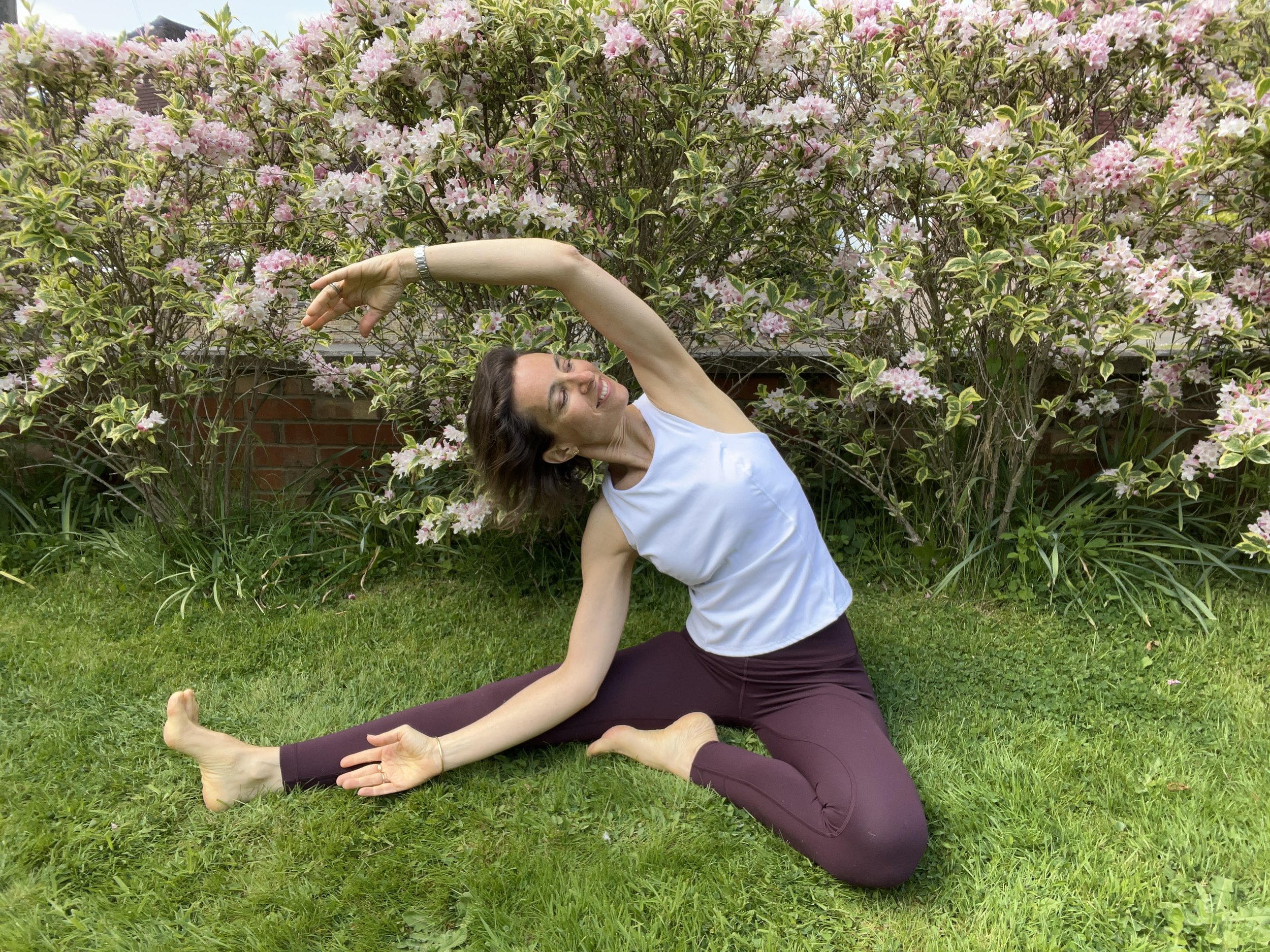
Practising outdoors, where it is easiest to remember we are part of nature, not separate from it.
When We Lose Touch With the Seasons
But what are the impacts of that disconnection?
Grounding, Your Immune System and the Soles of Your Feet
For a start, it can affect our immune system. In Qigong we ground ourselves, which simply means planting the feet on the ground. We send our awareness down to the soles of the feet, where they meet their support. That small action drops us out of the head and into the body, which can be a very good thing if, like me, you are a bit of a chronic worrier. We have a great many nerve endings in our feet, and bringing awareness there is often used as a mini reset. It is taught, for instance, in some GP practices, where doctors see one patient after another and need a compassionate pause between appointments.
When we ground ourselves, it is also said to help alkalise the body, making it a little less acidic, which can lower inflammation. That, in turn, supports the immune system.
Qigong is often practised outside, especially in summer when it is warmer. I often suggest practitioners take off their shoes and socks and simply stand on the ground. When we do that, our skin makes direct contact with the earth and we absorb its free electrons, a practice often called earthing or grounding. The research here is still young and the studies are small, so I hold it lightly, but what they suggest is rather lovely: those electrons appear to act as antioxidants, mopping up the free radicals that drive inflammation. People in these studies report less pain, calmer stress levels, better sleep and a more settled nervous system. Whether it is the electrons, the fresh air, the feel of grass underfoot, or all of it together, I have yet to meet anyone who regretted taking their shoes off in the garden.
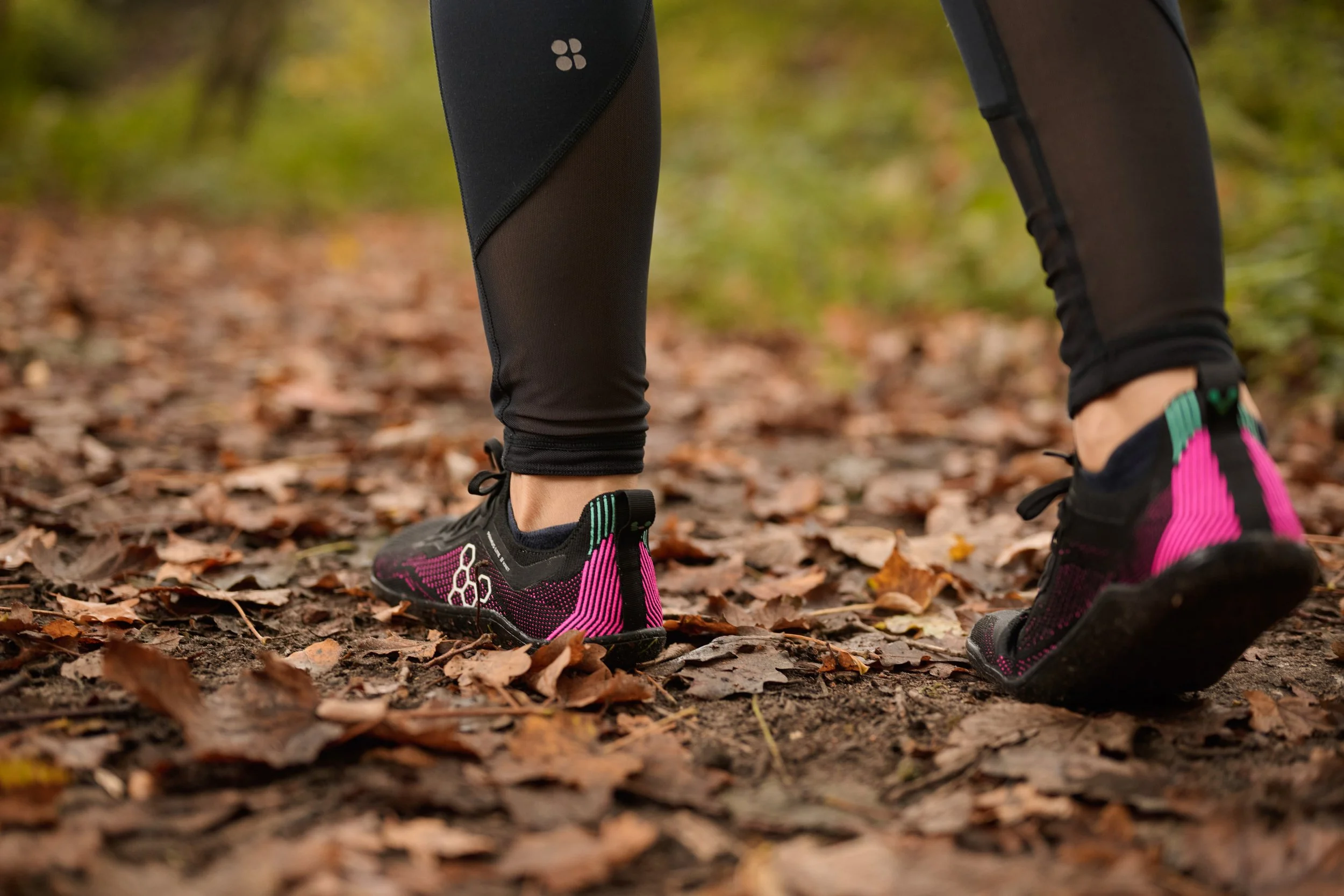
I have yet to meet anyone who came back from a walk in nature more depleted than they set out.
Why Nature Recharges the Nervous System
I also think that disconnection affects our nervous system. When we are cut off from nature, we deprive ourselves of one of the things that genuinely recharges us. Forest bathing, the Japanese practice of spending slow, unhurried time among trees, has become hugely popular lately for exactly this reason.
I am yet to meet someone who came back from a walk in nature more stressed and depleted than when they set off. And the link is not only anecdotal. A 2019 review of the research on forest bathing found that time spent among trees consistently lowered cortisol, our main stress hormone, compared with time spent in towns and cities. Other studies suggest that even twenty to thirty minutes outdoors is enough to bring stress levels down. Nature, it turns out, is one of the simplest medicines we have.
I also believe the cycle of the seasons gives us an anchor. When we moved from an agricultural economy to an industrial one, broadly the great shift of the Industrial Revolution, we lost the rituals attached to the farming calendar. That is probably the point at which we began to detach ourselves from the rhythms of nature.
I truly believe that having anchors in the seasons soothes the nervous system, because it gives our lives a rhythm.
The Five Seasons of Qigong
For anyone drawn to practices that rebuild our connection with nature, here is something I love about Qigong: it has five seasons, not four. Each season is linked to an element, and each element to its own organs and its own quality of energy. You will find them all mapped in the diagram further down, so I will keep the detail light here and focus instead on how each one feels.
Spring, the Wood Element
Spring is the wood element, and it is all about growth. Not growth in every direction at once, though, but growth with direction behind it. Energy leaks away when we try to grow everything at the same time, with no clarity or vision. When wood is in balance, it feels like clear, rising, purposeful energy, and its colour is emerald green. The practice itself, with all its precision, is designed to stimulate the organs tied to each season, and the movements borrow from nature, often from animals, such as the deer or the monkey.
Summer, the Fire Element
Summer is fire, and at its best it feels exactly as you would hope: joy, warmth, expansion, the urge to connect. Out of balance, that same fire can tip into restlessness, a racing mind, anxiety or broken sleep. Sometimes it goes the other way entirely and the joy simply drains out. Its colour is ruby red, and its movements often take the form of the crane, that most elegant of birds.
The year is always turning, each season with its own quality of energy.
Late Summer, the Earth Element
Then comes the fifth season, late summer, sitting quietly between summer and autumn from around mid August into September. Its element is earth, the steadying one, the element that holds all the others together. When it is balanced, it feels like clear thinking, solid ground underfoot, and the ability to say no when you need to. This is the hinge of the year, the turn from yang to yin, and it is the season in which we deliberately slow down and ground ourselves more. Its colour is a warm amber yellow.
Yin, Yang and the Nervous System
We think of summer as ascending yang, and from the next season onwards it is ascending yin, which reaches its peak in winter. Then yin recedes and yang begins to rise again from spring. As the yin yang symbol reminds us, there is always a seed of yin within yang, and a seed of yang within yin. In every season, we are aiming for equanimity between the two.
That balance matters because it affects our nervous system directly. Yang corresponds to the sympathetic nervous system, the fight or flight state, the part of us that is running the show as we go from meeting to meeting. Yin corresponds to the parasympathetic nervous system, often called rest and digest. Yin is what we cultivate in yoga when we practise active rest, through guided meditation, restorative yoga, sound healing and the like.
Autumn and Winter: The Art of Letting Go
Autumn, the Metal Element
Autumn is the metal element, and it is the season of letting go. At its best it brings a clean decisiveness, the ability to release what no longer serves us, and to grieve honestly, to feel a loss and still move through it rather than getting stuck. Its colour is a clear diamond white, and its movements often call on the white tiger.
Winter, the Water Element
Then we reach maximum yin: winter. This is the season I used to struggle with the most. Partly the cold, yes, but mainly because winter is all about resting. As I mentioned, we connect deeply with nature in this practice. In autumn the leaves fall, so it is the season of letting go. In winter the trees stand bare and nature rests. I had always pictured the sap simply going to sleep, but what actually happens is rather beautiful: as the cold arrives, the tree draws its resources downward and inward, storing its energy in its roots, and its whole system slows almost to a standstill. It is resting from everything it has spent since spring.
In our modern lives, I think this has become the most unnatural step of all. In cities like New York, which take pride in never sleeping, it has somehow become normal to never stop. And that is exactly why drawing inspiration from nature helps so much. We come to understand that flowers cannot bloom without pause, that in farming the ground itself has to rest before it can produce again, and that the same is true of us.
I wrote in a recent newsletter, after being named a finalist in a Health and Wellbeing business award, about how proud I am of the community around me. Because in this world of push, push, push, what I want for everyone who comes to my classes and experiences is simple: to stop, to pause, to listen to themselves, and to rest. Given that, it sometimes feels like an act of rebellion, and it is one I am proud to lead. The right to rest, without guilt.
In Qigong, winter's element is water, which is especially important because it represents the Dao, also called the Tao, the philosophy that underpins the whole practice. Its meridians are the kidney and bladder, and its animal forms are the bear and the turtle.
How the Seasons Talk to Each Other
The seasons, and their elements, are constantly relating to one another. There are two main cycles worth knowing.
The generating cycle, sometimes called the nourishing cycle, is where each element feeds the next. Wood feeds fire. Fire burns down to ash and creates earth. Earth, over time, gives rise to metal. Metal carries water, as moisture gathers on its surface. And water nourishes wood, so the whole circle begins again. This is the cycle of the seasons themselves: spring into summer, summer into late summer, then autumn and winter, and round we go again.
The controlling cycle is where each element keeps another in check, so that no single one runs away with itself. Wood controls earth, the way roots hold and break up the soil. Earth controls water, the way riverbanks contain a flow. Water controls fire, the way water puts out a flame. Fire controls metal, the way heat softens and shapes it. And metal controls wood, the way an axe prunes a tree. One cycle nourishes, the other regulates, and together they keep everything in balance.
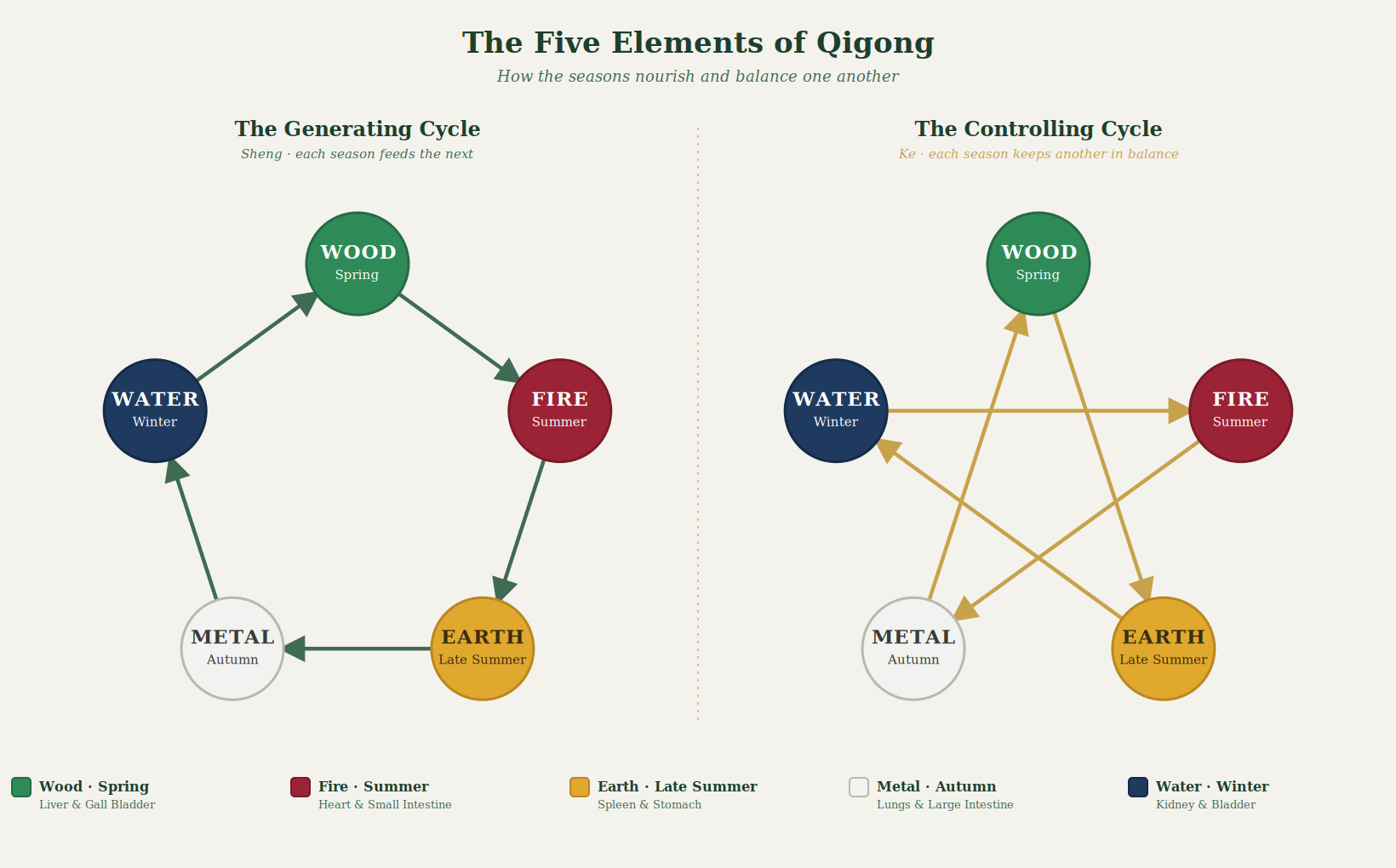
The five elements of Qigong: the generating cycle that feeds each season, and the controlling cycle that keeps them in balance.
Your Internal Seasons
So far we have looked at the seasons out there, in the world around us. But here is the idea I promised to come back to, and for me it is the most useful one of all. We do not only live through the seasons. We carry them inside us.
You can be in the middle of a bright, busy summer and feel as though you are deep in winter. It happens in menopause, when the whole inner landscape shifts. It happens through illness, through grief, through a stretch of work that has quietly emptied you out. The calendar says one thing and your body says another, and the gap between the two is tiring all on its own, especially when you are trying to keep pace with a summer you simply do not feel.
This is the point where the framework stops being merely interesting and starts being genuinely helpful. Once you can name your internal season, you can stop fighting it. If you are in an inner winter, the kindest and most intelligent thing is not to push harder. It is to rest, to draw your energy inward, to ask a little less of yourself for a while. The controlling cycle offers clues here too, a sense of what might gently bring you back towards balance. But honestly, the first step is simply noticing, and then giving yourself permission to be where you actually are, rather than where you think you ought to be.
The Real Advanced Practice
Developing this kind of inner awareness is, to me, the heart of any Qigong or yoga practice. As I often say, the advanced practice is not about standing on your head. It is about noticing how you feel, on the mat and off it, and adjusting what you do accordingly, rather than forcing yourself through some standard model. That, for me, is the quiet rebellion: a more sustainable way of living, for ourselves, for each other, and for the planet.
A Small Practice to Try
If you take only one thing from all of this, let it be this, because it costs almost nothing. Once a day, ideally outside, slip your shoes off and stand with both feet on the ground. Bring your attention down to the soles of your feet and feel the support underneath you. Take three slow breaths, and let each out breath be a little longer than the breath in. Then, before you carry on with your day, ask yourself one quiet question: what season am I in today? Not the one on the calendar, but your own. If the honest answer is winter, see whether you can give yourself one small permission to rest, even for five minutes. That is the whole thing. It takes less time than making a cup of tea, and it gathers up everything I have written about here: grounding, the breath, the nervous system, and the seasons, both inner and outer.
If any of this resonated with you, I would love to hear from you.
Want to try it?
I teach weekly Yoga and Qigong classes in Tonbridge and online, along with Yin and Yoga Nidra, private sessions, and regular retreats and workshops through the year. If any of this resonates, I would love to welcome you. You will find all the details at www.candiceyoga.co.uk.
About Candice Machtus
Candice Machtus is a Yoga and Qigong teacher based in Tonbridge, Kent. She supports busy people to restore balance, energy and clarity through embodied movement and nervous system regulation. Find out more at www.candiceyoga.co.uk.
FAQs: Qigong, the Seasons and the Nervous System
What are the five seasons in Qigong?
Qigong follows five seasons rather than four: spring, summer, late summer, autumn and winter. Each one is linked to an element (wood, fire, earth, metal and water), a pair of organs or meridians, an energetic colour and a particular quality of energy. Late summer, the extra season, sits between summer and autumn and is associated with grounding and balance.
What does it mean to ground yourself in Qigong?
Grounding simply means bringing your awareness down into the soles of your feet and their contact with the floor or the earth. It helps shift you out of a busy head and into the body, which can calm the nervous system. Practised barefoot outdoors, it overlaps with the idea of earthing, where direct contact with the ground is thought to have a settling, anti inflammatory effect, although that research is still in its early days.
Can spending time in nature really reduce stress?
Yes. A growing body of research links time in nature with lower levels of cortisol, the main stress hormone. A 2019 review of forest bathing studies found that being among trees consistently lowered cortisol compared with time in urban settings, and other studies suggest that even twenty to thirty minutes outdoors can help. You do not need a forest. A local park or your own garden will do.
Do I need to know about the five elements to start Qigong?
Not at all. You can simply come to a class and move. The seasonal and elemental framework is there to deepen your understanding over time, but it is never a barrier to beginning. Qigong meets you exactly where you are, whatever your age, fitness or flexibility.
What are the generating and controlling cycles?
They are the two main ways the five elements relate to one another. In the generating cycle, each element nourishes the next, the way wood feeds fire. In the controlling cycle, each element keeps another in balance, the way water puts out fire. Together they describe how the seasons, and our own internal seasons, stay in equilibrium.
What are internal seasons?
It is the idea that we each carry the seasons within us, whatever the time of year. You might be in the height of summer outside and yet feel wintry and depleted within, perhaps through menopause, illness or sheer exhaustion. Recognising your internal season helps you adapt your rest, movement and expectations to what you actually need, rather than to what the calendar says.
Where can I try Qigong near Tonbridge?
I teach weekly Yoga and Qigong classes in Tonbridge and online, as well as Yin and Yoga Nidra, private sessions, and seasonal retreats and workshops. You will find the full schedule at www.candiceyoga.co.uk.
